> For the complete documentation index, see [llms.txt](https://docs.xplatform.com/llms.txt). Markdown versions of documentation pages are available by appending `.md` to page URLs; this page is available as [Markdown](https://docs.xplatform.com/talon/concepts-and-architecture/microservice-architecture/development-model.md).
# Development Model
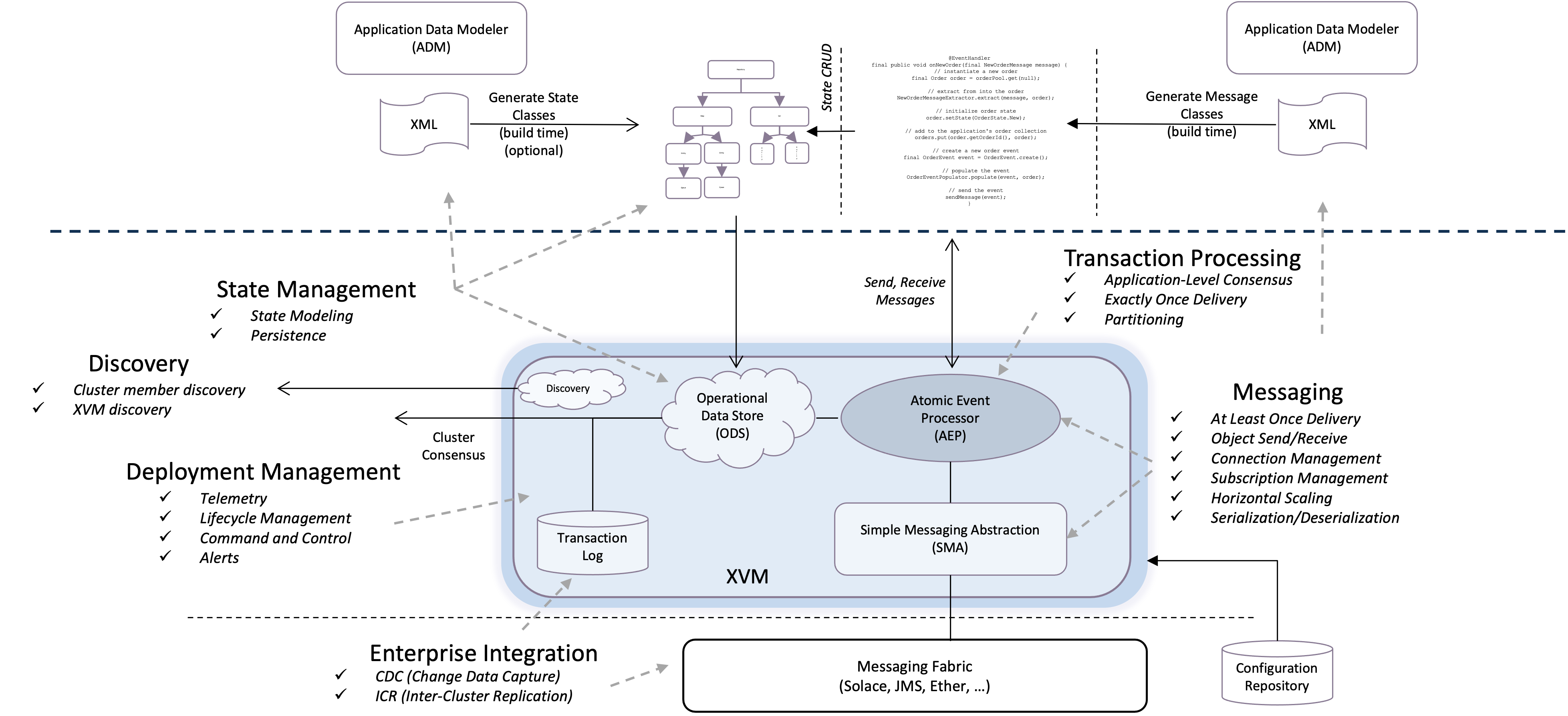
The following are the ingredients of a Talon application that a microservice developer works with:
* XML Models
* A message model
* One message model shared across multiple microservices
* State models (optional)
* One state model per microservice
* User code
* The HA Policy Declarer
* Lifecycle Methods
* Microservice Initializers
* Message Filters & Handlers
* Platform configuration
### Message & State Models
The **Application Data Modeler (ADM)** component of Talon employes an XML-based modeling language to define application messages and microservice stores. These XML models are inputs for the Talon code generator, which produces Plain Old Java Objects (POJOs) for the application's business logic. These objects are optimized for performance, enhancing developer productivity by managing object serialization, transport and persistence.
The following are sample message and state models
{% code title="Sample Message Model" fullWidth="false" %}
```xml
```
{% endcode %}
{% code title="Sample State Model" fullWidth="false" %}
```xml
```
{% endcode %}
See [**Modeling Message and State**](/talon/developing-applications/modeling-messages-and-state.md) for more information on modeling messages and state.
### User Code
The following is the user code for a basic Talon microservice. This illustrative microservice processes a `HelloRequest` message by updating a counter in its database and returns a `HelloReply` message with the updated counter value and an arbitrary string.
```java
@AppHAPolicy(value = StateReplication)
public class Main {
private AepMessageSender sender;
/**
* Invoked by Talon runtime at startup to initialize the microservice
*/
@AppInitializer
public void init() {
System.out.println("Initialized");
}
/**
* Invoked by the Talon microservice runtime to inject a message sender for use by the user code
*/
@AppInjectionPoint
public void setMessageSender(AepMessageSender messageSender) {
this.messageSender = messageSender;
}
/**
* Invoked by Talon microservice runtime just before it connects to the underlying messaging provider
*/
@EventHandler
public void onMessagingPrestart(final AepMessagingPrestartEvent event) {
System.out.println("About to start messaging");
}
/**
* Invoked by Talon microservice runtime to fetch the root of the microservice store
*/
@AppStateFactoryAccessor
public IAepApplicationStateFactory getStateFactory() {
return new IAepApplicationStateFactory() {
@Override
final public Store createState(MessageView view) {
return Store.create();
}
};
}
/**
* Called by the Talon microservice runtime on receipt of a HelloRequest message.
*/
@EventHandler
public void onMessage(HelloRequest helloRequest, Store store) {
// update store
store.setCounter(store.getCounter() + 1);
// send hello reply
HelloReply helloReply = HelloReply.create();
helloReply.setText("Hi There");
helloReply.setCounter(store.getCounter());
messageSender.sendMessage("hello-replies", helloReply);
}
}
```
The Talon runtime drives all user code within a Talon microservice. User-written code falls into the following two categories:
* Lifecycle methods
* Message handlers
#### Lifecycle Methods
The Talon runtime oversees the lifecycle of a Talon application by executing user-defined methods to handle various lifecycle functions:
* **Accessor Methods**\
The Talon runtime invokes such methods to gather user-specific data necessary for its operation. The `getStateFactory()` method above is invoked to obtain the factory used to instantiate the root object of the microservice's store. This ensures Talon can instantiation the microservice store at the appropriate point in microservice lifecycle
* **Injection Methods**\
The Talon runtime invokes such methods to supply the user code with handles to Talon runtime objects for use by the user code in its operation. The `setMessageSender()` method above us an example of such a method. Talon invokes this method, if implemented, to supply the user code with a an instance of the `AepMessageSender` object that the user code uses to send outbound messages.
* **Notification Methods**\
The Talon runtime invokes such methods to notify the user of lifecycle and alert related events. The `init()` and the `onMessagingPrestart()` methods are examples of such methods. The `init()`method is invoked to notify the user code that the main microservice class - `HelloService` - was just loaded while `onMessagingPrestart()` is invoked to notify the user code that the Talon runtime is about to connect to the underlying configured messaging bus.
#### Message Handlers
Business logic within Talon microservices is driven by messages. This means all business logic is executed through message handlers, which are methods marked with the `@EventHandler` annotation and recognized by their method signature. The `onMessage()` method above is an example of a message handler.
Message Handlers are single-threaded and should generally be non-blocking. They consume messages, perform business logic, query and/or update state and send outbound messages. The Talon runtime ensures that message receipt, state updates, and outbound sends are atomic, reliable, and loss-free, even in case of failures.
See [**Authoring User Code**](/talon/developing-applications/authoring-user-code.md) for more information on writing event and message handlers.